• So I’m shallow

    I’m reading The Shallows “” or trying to, because the author seems to be making his point by making you read about every effing thing from the invention of the watch to the invention of type to”¦ everything in the universe that precedes his point. Me-smells an article that’s working hard to be parlayed into a book.

    That said, I do want to cultivate mindfulness, deep thought, and sensory experience/first thoughts over skimming the world. But sometimes a lack of patience is warranted!

  • Really writing a book

    In-between bouts of copywriting, I’ve been working on my novel.

    I know, I’ve been saying that for more than a year. That was research, and it was important; I couldn’t have got here without that.

    This is different. This is working on a book, like I remember it.

    Last night I completely rebuilt my e-books, which I’ve been wanting to do for a while now (especially now that I have an e-reader, and I wasn’t happy with how the old versions looked; I knew I could create a better, more “professional” product). In the process, scanning through all those chapters and scenes and seeing those old, beloved characters’ names again, I was reminded of what “writing a book” was like at its best–when it wasn’t about pressure or keeping up or proving myself or doing what I’m supposed to be doing, or any of that. It was about creating, discovering, having a conversation with my creative subconscious.

    And now, this work has thrown me right back into the middle of that activity and that feeling–just as fresh as fun as it was in 1998, when I was writing my first book. Only now, and especially now that I’ve got over whatever was in the way and am into the work, I feel confident that I am more capable than ever.

    I’ve worked out a lot of this story.

    And just now, as an exercise to ease into the story, to give myself the freedom and permission to write just for myself, without consequence, I wrote a “missing scene” from the story. And you know what? It was easy. I mean, it was work, sorting out the beats of the scene, then writing it, but it was work I can just do.

    Craig just got home from his Spanish class and insisted on taking me outside to see the sun–a giant ball of orange gelato sliding out of sight behind the neighbours’ slate roofs. Now he’s off to the shop for a minute and I’m finishing this. The sky out my window is still pinky-orange. Across the street, a gull sits nestled beside a chimney-pot. It’s a warm, kind day that feels like the start of summer, even though a theatrical fog is rising from the harbour.

    All’’s right with the world.

  • DIY Book, Episode 26

    A quick video demonstration of “fan-binding” the pages of a paperback book.

  • Word makes world

    The last few days I’ve been stopping to catch my inner monologue and replace it with something less driven, more compassionate, more useful, more fun. What a joy! And why not? Why does the other monologue feel “realistic”, like I somehow have a responsibility to run that tape of wearying, demanding voices?

    This afternoon, having cooked dinner and made pudding for my brother & his family while they drive up from Inverness, I sat on the couch. I lay down and napped for a while. I straightened up and read for a bit. Then”¦ I stopped. And looked.

    It felt like waking up a second time. I looked at the plant winding its way up in the corner of the living room””three charmed, skinny wooden snakes with leafy headdresses, and I sunk even deeper into the moment.

    This is the other thing I’m remembering in these moments of moments: the feeling of living twice by observing things through the filter of How would I write that?

    As I transfer all my notes from last year (in my Gregg shorthand of the time””ack!), typing them out onto 3×5 cards, I look at the task ahead in writing this novel and I know that what I need to succeed at this again (can I say that?) is interiority. I want my inner life back. My attention. My original “Wild Mind”, as Natalie Goldberg calls it””she whose book of the same name first got me started on this writing path.

    In that place, writing becomes something completely different. A line from Rumi comes to mind””which I think Natalie quotes in the book:

    Out beyond ideas of wrongdoing and rightdoing, there is a field. I’ll meet you there.

    It feels like a religious calling, a coming back to faith, because writing is the best thing I’ve found for helping me fully experience this world and feel like I’m engaged in a practice that takes me closer to whatever it’s about.

  • On editing, so as not to troll

    I’m on a break between deadlinedeadlinewriteitnow! copywriting assignments I’m trying to finish before my brother, sister-in-law, and nephew arrive, and, lost in some web-browsing, I was about to post the following in the comments for a blog article called “Holding self-publishers to account for quality”.

    As my cursor hovered over the “Submit” button, I realized I really don’t want to get into any debates on the internet. I hate them, they do nobody good, and long, hard experience has taught me to steer away from that moment where something in me gets hooked and wants to pick a fight. So I closed the tab.

    “¦but I did save the text to my clipboard. I might as well bleat my point here on my own little hill where it hurts nobody. (You can infer from the title the gist of the original poster’s thesis.)

    You’re judging all self-published work here by a single bad experience. You’re not alone in doing that””it’s the default position: “Self-published work is shoddy.” Yet every traditionally published book I’ve read this year has contained typos””so, as they say, that dog don’t hunt. The argument may once have held, but now it seems to be the nasty refuge of writers with a hope-horse in the traditional publishing race.

    What’s apparently being left out of the process on both sides is good editing; perhaps that’s because this is a human skill that hasn’t been””can’t be””commodified the way print production has. With a shrunken budget in either case, it gets skipped.

    That said, editing is something I want to invest in for this next book. The price is generally ghastly, which I can understand, given how time-consuming it is, but later down the line I’ll be searching to see if editorial services are turning up in the wake of the indie publishing armada.

    Suggestions welcome!

  • Career perspective

    Yesterday my hubby gave a patient back his voice (using a little piece of plastic to attach to a tracheostomy tube, which cost £50 and the NHS fought him about buying). The same day, a young patient of his died unexpectedly.

    I’m busy with my copywriting work right now, trying to work on the novel, to learn shorthand, and a do a bunch of other things. It all seems pretty minor in comparison, though. Not unimportant“”this is my calling””but the games we play have very different stakes.

  • Researched to bits

    Tonight I finished the research for my fifth novel. Phew!

    In a sense, that was the easy part, because there’s no personal risk in doing research. And yet, there’s always this sense of needing to earn the right to write about the topic, which just gets deeper and deeper the more details you discover.

    That notion is garbage, though, creatively speaking, because at a certain point — the point I’m at now — I have to take a leap and just make something up.

  • Switching shorthands

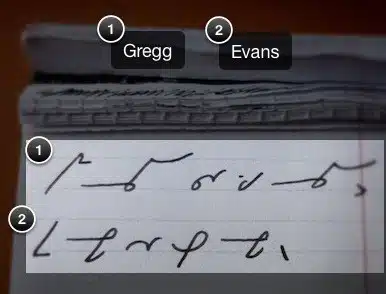
    I’ve started over, and am learning Evans shorthand after spending about two years learning Gregg shorthand.

    It’s a lot of work, taking new shapes for sounds and pasting them into my head over old ones, but the groundwork I did in learning Gregg has been extremely helpful. My mum sent me a scan of a page in her Pitman book, and I could immediately spot the similarities and differences: all of these systems are trying to do the same thing.

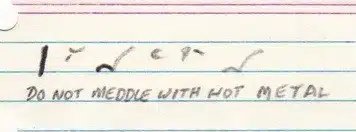
    What I like about Evans, why I’m ultimately choosing it over other systems, is that it’s compact. Here’s a sentence in Gregg, then in Evans:


    This vitally important piece of communication is “Do not meddle with the hot metal.”

    My handwriting has always been small and controlled, and when I make notes I tend toward what’s called “sketchnoting“. My frustration with Gregg is that it’s so big and loopy that, to my hand, it felt like going down stairs on roller skates. And it didn’t fit into call-out boxes beside illustrations; it wanted to escape off to the other side of the page.

    So hello, Evans, and thank you.

    The thing I find most confusing about it so far is that Gregg was rigidly phonetic (with diphthongs spelled out in full”””white” becoming “oo-i-te”””tedious!) whereas this sometimes switches and honours the double sounds of Roman letters, so C can be a K-sound or an S-sound. To my Gregg-conditioned mind, that’s heretical. But it has Xs and Ws and Ys, for which I am very grateful.

    /end of shorthand geekery. Thank you for your patience.

    EDIT: Mom sent me the same phrase in Pitman’s:Phrase in Pitman's

  • DIY Book, Episode 25: Gregory Crawford

    Interview with Gregory Crawford, who used the DIY Book process and Kickstarter funding to produce his novel Fall Apart Park.

  • Goodbye, car

    The reason we went to Inverness this weekend was to buy a car.

    Old Car, thank you for not killing us. I tried to drive you, but you were a bugger. Still, you showed us lots of nice stuff.

    New Car, welcome to the family. Please don’t kill us. I hope we have lots of nice times together. Because I was there when we got you, somehow I feel more like you belong to me, and am inclined to learn how to ride you.

    I still wish there was a better alternative to everyone owning a car and endlessly burning up petrol. But this was a necessity for Craig’s work, because the old car could barely crawl up the 13% incline of the Berridale Brae, which he travels a few times a week, and it had trouble overtaking tractors and such quickly, which is important on our tiny, deadly roads.

    Cars, mortgages… this husband is dragging me into western adulthood!