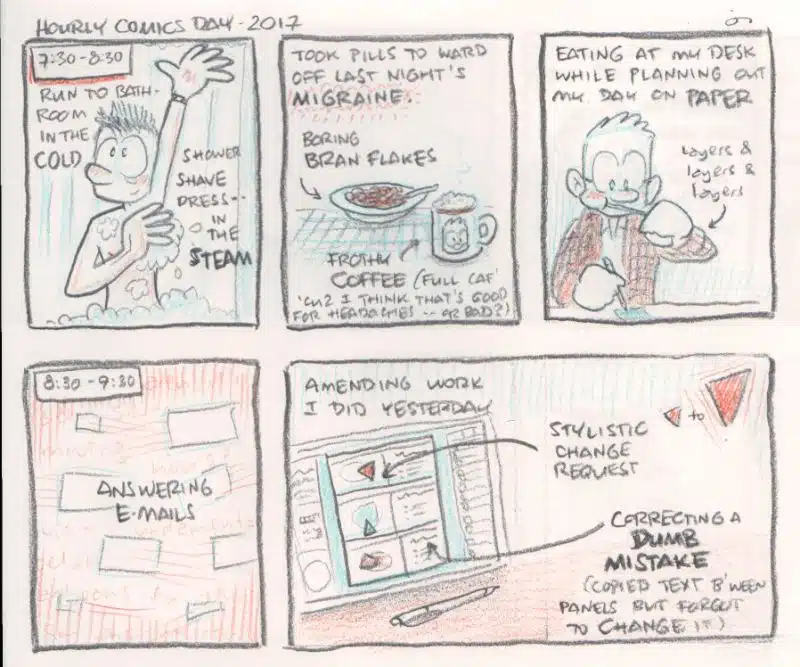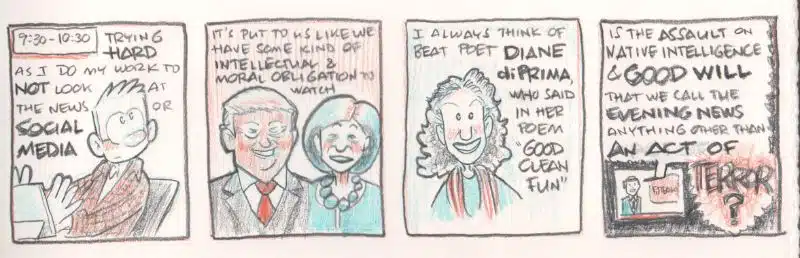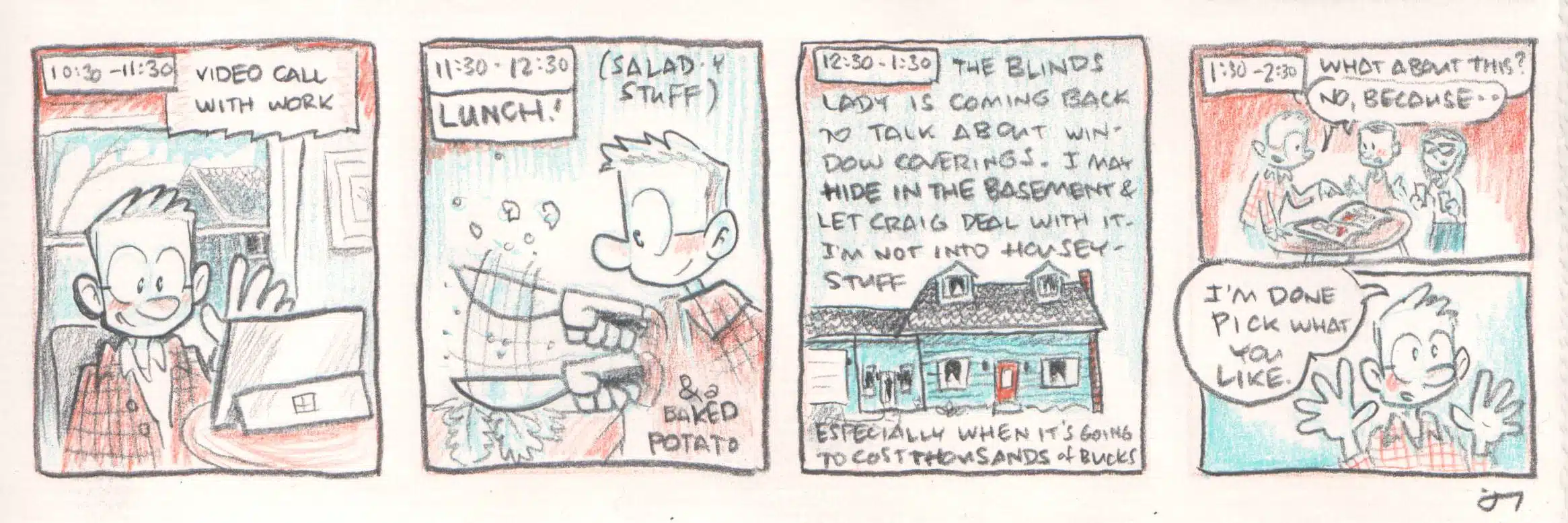
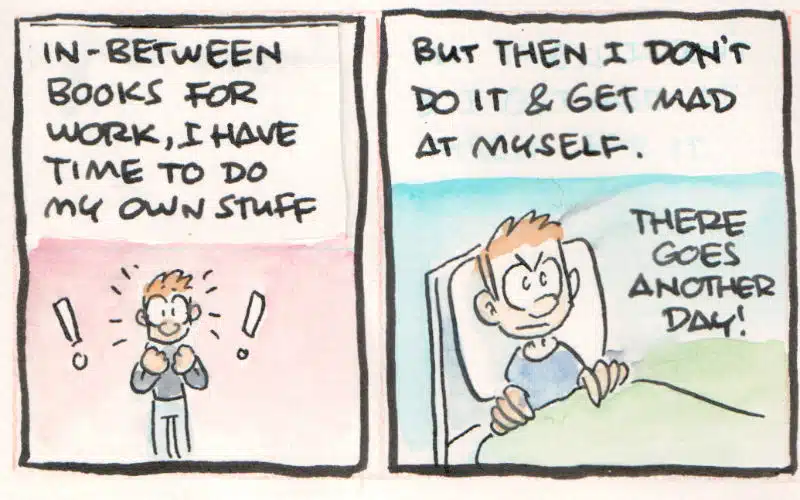
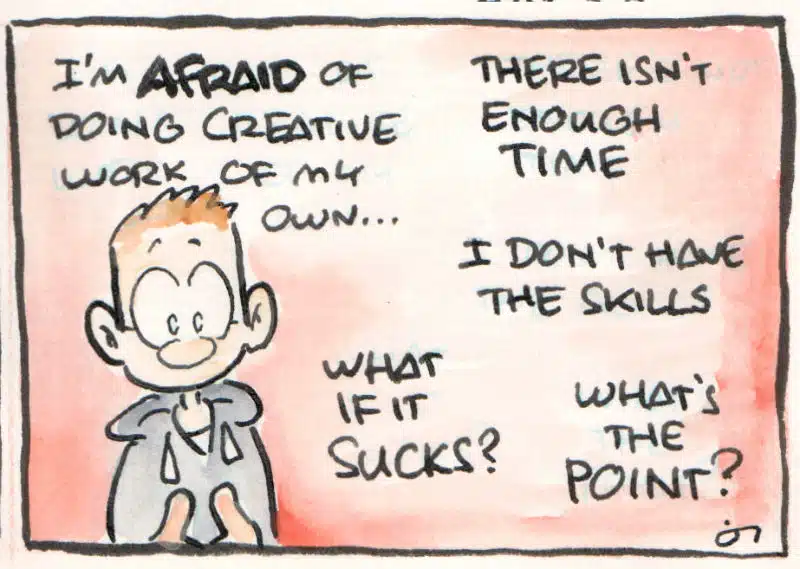
I finally got back to my sketchbook.
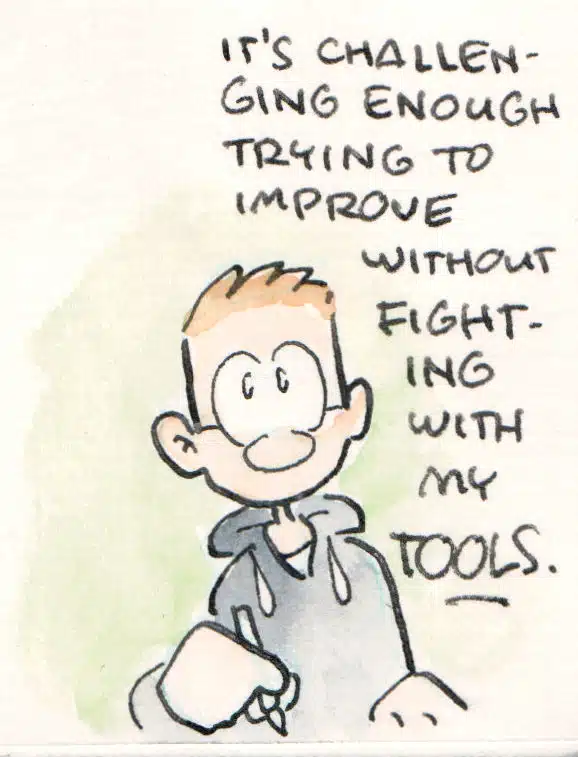
I finally got back to my sketchbook.
One of our clients at work has a son who wants to be a cartoonist, so I just wrote a little “inside peek” at how I do my work for Strategic Coach. I figured I should share that here, too.
When I was a kid, I was totally obsessed with coming up with my own characters (“copying” was a swear-word to me). Unfortunately, though, I stopped there, just drawing each character standing still, over and over.
Working with Dan has been a brilliant challenge for me. He’ll say, “I picture dozens of entrepreneurs jumping from one platform to another, all of them looking and doing something different.” Um… okay! As a result of taking on these challenges, I’ve learned a ton, and my skills have just exploded over these past few years.
In other words, I’m finally drawing characters in comic strip panels full of action.
The biggest tip I could give about drawing goes back to all those books on cartooning I read as a kid — although at the time I found their advice constantly frustrating — as is summed up perfectly in this internet meme:
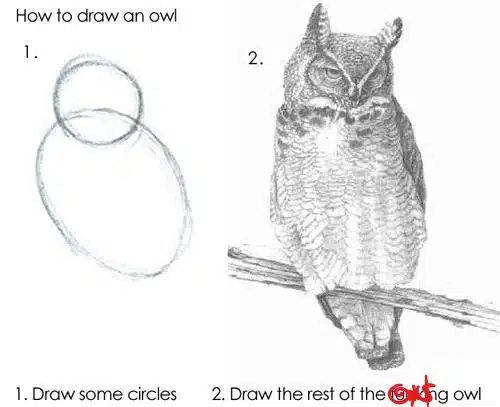
But I’ve finally caught onto this principle, called “under-drawing”, and it’s made a huge difference in my abilities.
Putting pencil to paper and producing a finished drawing is like walking out of the shower, onto a stage, and performing an opera. Sure, there’s probably someone who can do it, but most of us mortals need to rehearse.
In comics, the equivalent to that rehearsal is “under-drawing”: using a light “non-photo blue” pencil to rough out the shapes that make up your character and scene, then going in with your pencil or ink to do the final lines — the “performance”.
The advantage is that it makes everything hold together — whereas if you just start out somewhere in the middle and go from there, you get some pretty weird anatomy happening, find your words all squooshed into a corner, or you make a mistake you can’t undo. (Okay, I do my final Coach work in software, so, yes, I can undo it. But I can’t Control-Z on paper. I do often find myself trying to “pinch-to-zoom” on paper as well.)
So this is how I work:
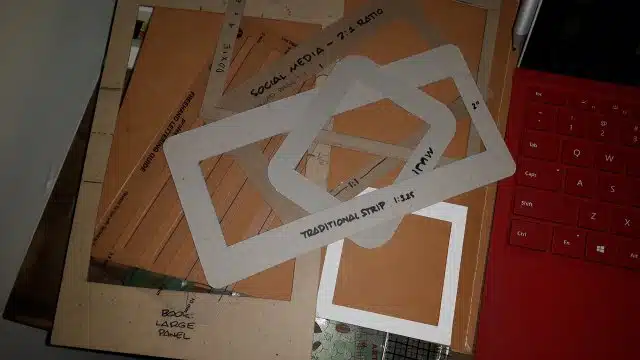
1) I’ve made cereal box cut-outs for all my different sizes of comic panels. So I start by tracing out my panel on paper.
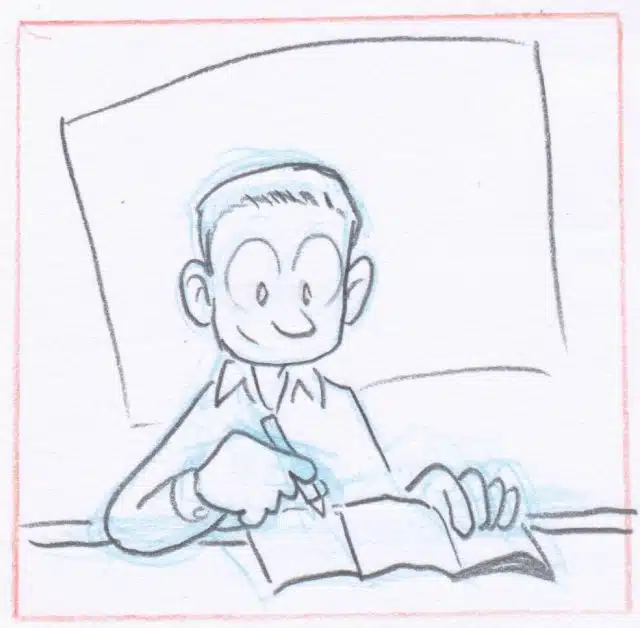
2) Inside the panel, I rough out the geometric shapes that make up my characters and the scene. Then I go over the lines in pencil. (You can see my blue under-drawing here. I had trouble getting the hands and the book right!)
3) I scan this and bring it into the program where I do all my cartooning work, Clip Studio Paint. It’s a complicated monster of a thing, translated from Japanese, but it is incredible. It does absolutely everything — like Photoshop on steroids, just for cartoonists. Unlike Photoshop, though, which is $50 a month forever, Clip Studio Paint is $50… once. I don’t get how it can be so cheap, but I’m grateful to the people who make this miracle of a thing.
I was spinning my wheels trying to understand it until I found some great YouTube videos that helped me get started, and I’ve been learning something new just about every day since.
4) In Clip Studio Paint, I can turn my real-world grey pencils into blue lines again — like digital under-drawing.
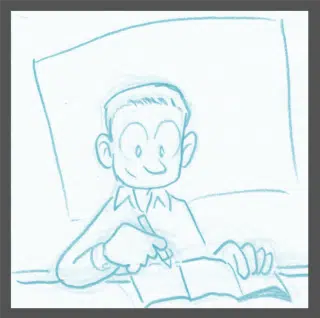
5) I do my final “inks” on the computer. Clip Studio Paint has layers, and I use those a lot. It’s so much easier than drawing permanently, destructively on top of your original. So I create a new layer and ink on it.
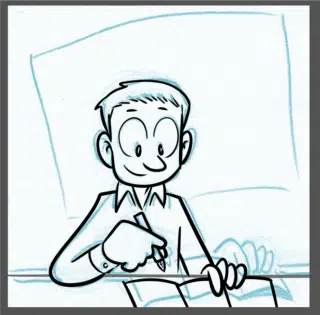
6) With my inks in place, I turn off the blue layer, create another layer underneath my inks, and colour in the character. (In the comics profession, this is called “flatting” — probably because “colouring-in” doesn’t sound like a job somebody would get paid for.) Some of the brushes make hard lines, whereas others are soft, like watercolour brushes — I like to use those for shadows. (You can see those softer brush-strokes on his cheeks, hand, arms, and hair.)
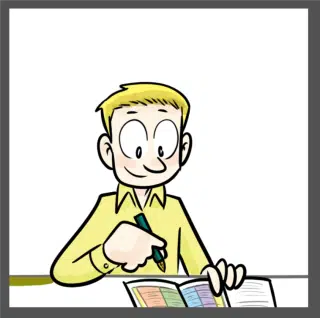
7) Then I put in a background on another layer.

8) Now it’s time for all the decoration and special effects, which I putter around with a lot — but, since they’re on their own layers, they don’t damage my foreground character at all.
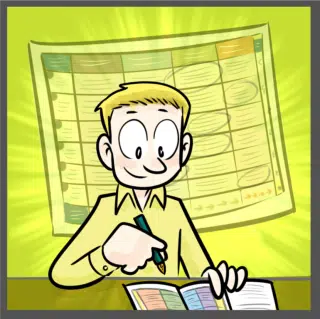
And that’s how I make my cartoons for Strategic Coach!
I hope that’s helpful.
They’ve released a (meandering, kinda pointless) scene from Alien: Covenant. But there’s an incidentally gay couple in it – just two blokes, not spaceship interior decorators. Weird that this still feels like a breakthrough.
EDIT: One of the commenters on that page made a good point: This is supposed to be a colonizing spaceship. So, yeah, sending a gay couple to help populate a world doesn’t make sense. Maybe they have some sort of essential skills… like decorating. Oh, God.
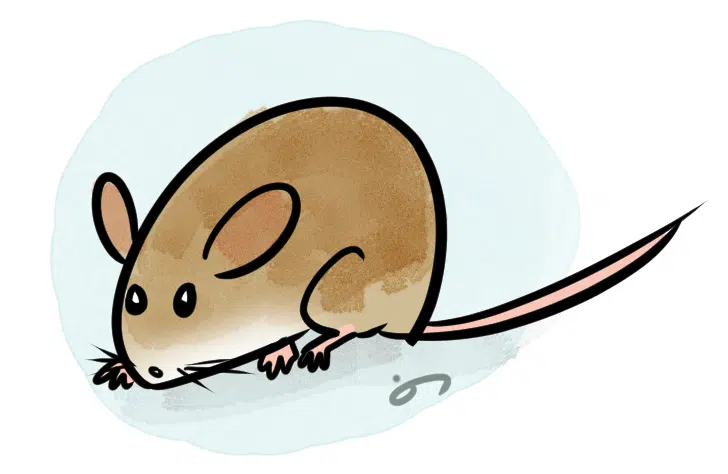
I made a wee friend the other day. He was freezing to death on the path in front of our house. I went inside to get some food for him, and, on returning, found him on his side, seemingly perished.
So I took him inside, where we warmed him up, made him a wee nest in a big plastic tub, and fed him. He made a full recovery!
…Then escaped during the night and is now somewhere in our house.
Oops.
Cribbed from an e-mail to a friend…
My clicky-finger was hovering over the ‘Deactivate’ button on Facebook just a few days ago.
I hesitate to share anything there because I don’t want to deal with the volume or possible negativity of others’ reactions. Yet, as a creative person who’s enough of a wank to need applause, I enjoy having someplace to share things where I know people will see them. (Twitter used to be that, but I have a weird feeling that Twitter is dying.)
If I thought anyone would ever see my blog, I’d just stick to posting there, because that’s my space, and I have some creative control there. I don’t particularly want to advance Facebook’s thing. (Especially when I’m on my phone and it recommends horrible pages by horrible Americans saying horrible things.)
I wish I could just ignore Facebook, but somehow it has a gravitational pull, especially in those empty moments when I’m spent. But when I do pull myself away and read or even just look up, life feels better.
This is a long podcast interview between cartoonist Chris Schweizer and educator Jerzy Drozd, discussing non-violence in comics — but it really extends into every story in our culture, and the way violence is so often presented as the de facto solution to every conflict (e.g. Marty McFly is a chicken unless he punches Biff in the face, and his doing so instantly resolves the situation).
This is an idea that keeps coming back to me lately: “What is peace?” How can we be peaceful, especially when faced with an opposing force hell-bent on violence, or unwilling to engage with the level of thought and empathy that makes peace possible?
As John Lennon said:
When it gets down to having to use violence, then you are playing the system’s game. The establishment will irritate you – pull your beard, flick your face – to make you fight! Because once they’ve got you violent, then they know how to handle you. The only thing they don’t know how to handle is non-violence and humor.
I’m grateful that my work gives me the time and space to listen to long-form discussions like this in the background!
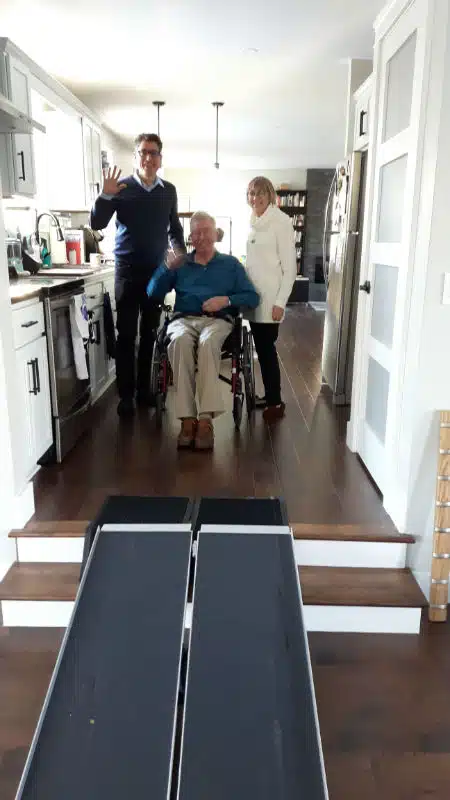
Thanks to the ramp my mum bought, Dad was able to visit our house yesterday!