Category: Uncategorized

  • More on e-reading (moron e-reading)

    Okay, fine, laugh at me.

    In the spirit of Whitman (“Do I contradict myself? Very well then I contradict myself, I am large, I contain multitudes”), I’ve just bought an e-reader. I picked it up on Amazon, cheap-ish, because I must admit that I’m finding it a strain to read the teeny-tiny type produced when I publish some PDFs as books.

    Plus there’s this:

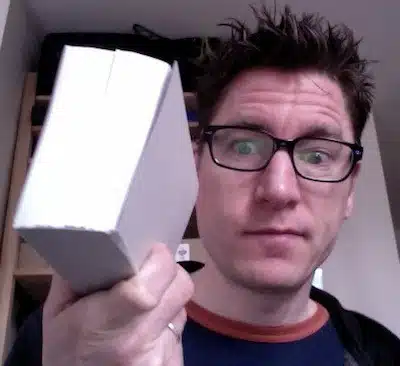
    Me with a big book

    I can’t really be bothered with doing all that binding work over and over, nor trying to carry a few of these in my bag.

    We’ll see how I like it when it arrives. I bought the Nook because it can apparently be “rooted” — made into a plain Android device rather than being a dedicated purchasing conduit for one particular shop (in the States).

    But I want to stay human and use it as a way to take ideas along with me, not to have a toy that I’ve constantly got my nose in. I struggle enough with that on my computer.

    Speaking of which, the haar is lifting, and the fella and I are going for a drive, so I must get a move-on.

  • Still no to e-reading

    A friend e-mailed me last night, telling me of her misgivings about the writers’ retreat she’s committed herself to, especially now that one of its leaders has mentioned she’s looking forward to being a “midwifeâ€.

    Stories aren’t precious gossamer things sneezed out by fairies. I think that’s how we start making the work difficult and unapproachable for ourselves.

    I’m reading an excellent guide to sitcom writing right now* that does a great job of identifying all the elements of a good comedy. I’m struck by two things:

    1. The authors make it all sound really fun, like you just can’t wait to try it. So that’s nothing like having to “birth” something, which is a process that seems more likely to create another generation of self-destructive, alcoholic, self-obsessed writers.
    2. I’m reading ‘cause I want to make this book a comedy rather than the Very Serious Thing it could be. Seeing a story as a new-born human life… that’s way too precious to be enjoyable for the reader.

    *I had to buy the guide as a stupid Kindle book to get it, but I don’t have a Kindle. I seriously considered getting one because of all the PDFs I’m dealing with lately, but, once again, I decided I really don’t want to try and read from a thing that contains all kinds of books at once that I could flip between — I just want a book to be a single-purpose focusing device. More importantly, I can’t stand the way the screen on these things inverts as it flashes from page to page. Real books don’t flash at you!

    I’m not just being a cranky digitalphobe about this. Staring into a piece of tech has a particular effect on my brain that I don’t like, and isn’t compatible with what I want reading to be.

    The solution? I spent far too much time figuring out how to crack the file (which I bought but is locked up in digital protection) so I could print it out as a real book. The most difficult thing about it was that the formatting of the e-book is unforgivably dreadful:

    No matter how hard I tried, there was just no find-and-replace way to fix it. So I just printed it as-is.

    Still, at least I can hold the resulting book in my hands, read it, and focus on it. I would return the Kindle mess on principle because of the careless way this commercial product was made, except that hardly seems fair to do that when I’ve got the benefit of the content; I don’t want to deprive the authors of their deserved income. So I’ll “keep†it.

    EDIT: I mentioned the formatting in my Amazon review, and one of the book’s authors contacted me. I offered to help fix the book, and he took me up on it. I do really enjoy that aspect of modern digital living: everyone in the global village lives on the same street, and sometimes you get to talk to some really interesting neighbours.

  • Novelist’s Nightmare

    I had an actor’s nightmare yesterday morning: the whole theatre department from my university had reassembled at to re-stage the production of Romeo and Juliet we did in 1988, except now we were using the text of Measure for Measure, and I couldn’t get a script ’cause we were all supposed to be off-book — even though I’d just been brought in and hadn’t had any rehearsal.

    I think this is about the novel: it’s still in development and I’m not able to “perform” it yet.

  • The Spies Who Left Me in the Cold

    I’m loving this new time-keeping thing. It’s helping me balance copywriting, working on a novel, and having time in the evening with the hubby, too. You mean I can feel purposefully engaged and be happy? Now that’s more like it!

    It helps that work is quiet at the moment, and I’m grateful for that. And last night I blurred the line by asking Craig to watch Tinker, Tailor, Soldier, Spy. Shame it was kind of choppy and dull.

    That’s the second movie adaptation of a LeCarré novel I’ve seen this week that made intrigue seem boring: Listless characters, endless off-stage happenings and people you need to keep track of in order to follow the plot, and all the twists amount in the end to everything turning out to have been generally pointless.

    So I don’t want to write anything like that.

  • Research versus worry

    For a year now, I’ve been collecting pictures, web clippings, video files, and anything else even vaguely related to the novel I’ve had in mind. Ironically, the reason I’ve had such a hard time getting into this book is because it’s set at a particular time in history (Cold War Canada, specifically 1967), so I felt intimidated by all I don’t know about the period and its events. (I wasn’t even born for another year!)

    The solution in this, as perhaps in all things, was to ask myself questions. Small questions. The result of one of those questions was the realisation that I needed to break all this research down into digestible bits; there was no way I could just absorb it all at once.

    I’ve been using the great Scrivener app to gather my background material, because I’ve been finding it so useful in my copywriting and it’s really designed with novels in mind. Still, there are just so many files in there, and while random access (“dip in anywhere”) was a great speed-boost in computing, it’s not a great way to think through things.

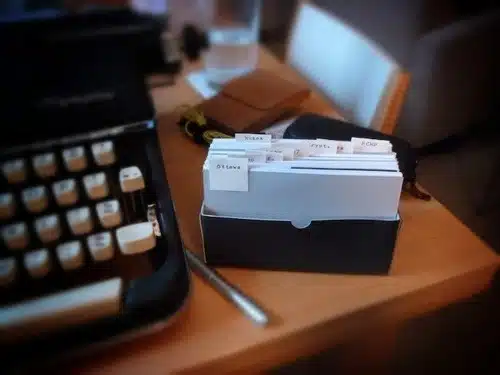
    Scrivener makes it easy to print out a 3×5 notecard for every file, so that’s what I did (and naturally I also made dividers, tabs, and a box for them all).

    Now I’m going to go through each file and boil it down to the information that’s relevant to the story. All of this is before making final decisions about the plot and characters, because the research inevitably spawns new ideas. So, about those elements, I keep reminding myself you don’t have to know this yet.

    The up-side of living in an info-deluvium age is that, when it’s time, I can likely find whatever facts I’m missing (like the weather on any given day, which is a good bit of detail to add, as Canada is not California!).

    Ultimately, though, there’s a point where one just has to commit to creating a work of fiction. I don’t want to be too careful here or the whole thing will be boring — for me and for the reader. In fact, come that point I want to set my homework on fire and dance over the flames.

  • It’s about time (planning is)

    I have a secret: I’ve been working on my novel again. Like everyone, I suppose, I have this internal voice that says, “Don’t tell anyone about that. You didn’t manage to do it the last time, and it might still fall apart again.”

    I know that’s not going to happen, though. That inner critic (his name is Mr Mudflaps) is trying to use that routine, “You never finish anything you start”, but at this point in my life that’s so patently untrue that it just isn’t sticking.

    The novel is gaining momentum, and I keep waking up with my subconscious having left new clippings from it in my brain (one of the characters spontaneously changed race yesterday morning, adding a completely new dimension to her part of the story). Best of all, I’m getting swept up in memories of how much fun it’s been in the past to be in the middle of working on a book — making up a story from nothing (plus a lot of research) and getting to know imaginary people and events.

    For some time I’ve been “running a racket” (i.e. repeating a persistent excuse/complaint/story) about how it’s so difficult to do creative work while being in a happy relationship. That’s a real error in my communication, and a huge disservice to my wonderfully supportive partner. Happiness does not limit me, and I will not support in any way the trope that it’s impossible to be creative without an attendant depression or mental illness.

    This is why I’ve put aside The Artist’s Way: While I’ve been enjoying writing “morning pages”, the bulk of the material in that book/course is very cranky and “blamey”: “Who was the first person who told you [X or Y],” “Who do you need to remove from your life in order to honour your creative blah blah blah”¦”

    I’m really not into looking at the past because it’s, you know, past. It might be very informative to see patterns, but ultimately what matters is forming new and better patterns, so I’d rather just get on with that.

    And as for that twelve-steppy psychology of blame she uses, again, it would be terribly unfair to criticise my family or childhood teachers when, in fact, I’ve always received a lot of encouragement for my creative abilities. I remember my parents oohing and ahhing over early cartoons that I now realise could only have looked perplexing or wildly deformed — but that bolstering gave me the incentive to continue drawing, and now, even without regular practice, I can draw whatever I like.

    The book’s author also uses expressions like “toxic friends.” Well, you know what? I’m big enough and smart enough to not have a life like that. And that’s a crappy way to regard other folk. If you want to do something, just get on with it and don’t make others wrong if you’re not saying “No” when you need to.

    Finally, my beef with The Artist’s Way and so many other things like it is that they make you feel good and give you all sorts of little creative boxes of chocolates and bags of bath-salts, but you still don’t end up doing the work. It’s something to do instead of writing or painting or whatever your thing is.

    That’s not to say that how you feel is irrelevant — feeling hopeless or doubting yourself makes it very difficult to do the work, so I’m taking time to create a positive mental environment and a state of mind that’s big enough for the task at hand, which really does help. But I’m reminded of Natalie Goldberg‘s wonderful books, which first inspired me to start writing seriously by capturing all the “holy details” around me: that was good up to a point, but filling books with discursive pages of rambling and “Me, me, me” wasn’t giving me anything I could put into a book and out into the world for others. (No, because clearly “Me, me, me” is the domain of blogging.)

    There’s a wind-storm banging at the windows of my imagination, saying, “But writing is different from cartooning! It’s serious, and everyone’s a critic. What if they hate this story?” Well, for one that’s not my past experience with my writing. But more importantly, I’m getting deeply into this story enough that other people don’t matter. I want to discover it; I want to know where it goes and what happens to these people.

    I’ve been reading about “modelling excellent behaviour”, and looking about for best practices in writing. Of course, what I’m discovering is nothing surprising. Whether it’s at four in the morning or after the kids have gone to bed, working writers spend some time during the day writing. I know from my past experience that it doesn’t even have to be much in order to get a book written. (My actual writing sessions were usually only an hour to three hours long.)

    Which brings me to another racket it’s time to close: the idea that I can’t switch gears, that I need to have endless stretches of time and solitude in order to write. Those are nice, but ultimately the shift happens in a split-second, when my brain goes from not committing to the work to committing to the work. So that’s what I need to get a handle on, not the other luxuries (which also require a lonely existence, and I’m not about to go back to that).

    Here’s the real kicker: my searches led me back to DIY Book, where I discovered a bunch of things I knew and had forgotten about. All the structure I need is already laid out there, and is perfectly suited to my working style. (Go figure, eh?)

    And what of this question of time? Well, time moves quickly when you’re in flow, but it only slips away when you’re wasting it.

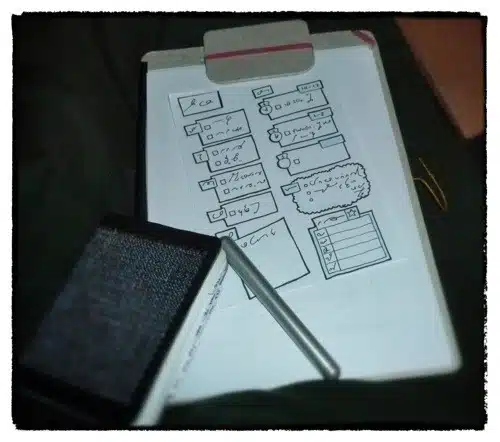
    I redesigned my daily planning sheets, because this new focus on writing the book needs some dedicated time — which made me realise that, yes, it does, and so does everything.

    The way I’ve been planning so far has been good to a point, but it’s a bit like stacking a bookshelf all the way up to the ceiling without anchoring it to the wall: sometimes it all comes tumbling down. So for my three crucial results for the day, I’ve provided spaces to anchor them in time: “When exactly is that happening?” With that in place, I’ve discovered there’s actually a lot of time left over for eating, making, thinking, researching — playing, I suppose, since everything I do is, at its best, really a form of play.
  • Friday sewing mayhem

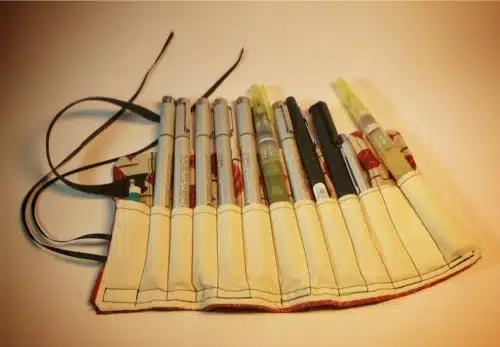
    The end of the work-week seems to be when I finally getting around to sewing the next thing I had in mind. This week’s project was a roll-up pencil case for holding my drawing pens, water-brushes, and pencils. I found a set of directions online for making one of these for kids to put their crayons in.

    Do you see the problem here? How did I not?

    Crayons are much smaller than pens, brushes, and pencils. Ah well. It’s still more useful than the cardboard box they were all rolling around loose in.

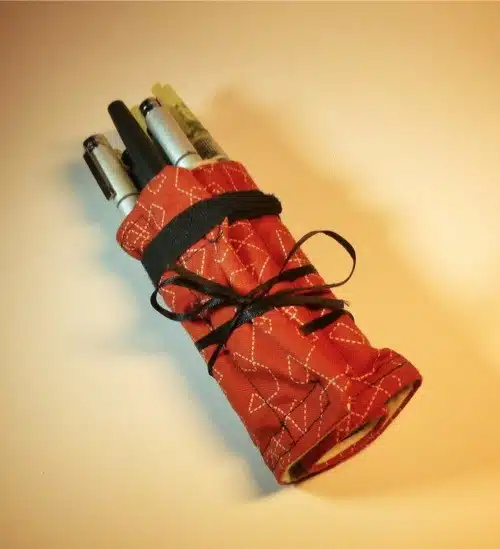
    The ribbons in the original design were clearly not going to hold this all together, so I went for the big guns and added a piece of Velcro, thereby further lowering its aesthetic value, but raising the chances that I’d actually use it. Not sure I should take it on any airplanes, though, given its resemblance to cartoon dynamite.

  • Frankenpen, or the art of knowing when to say “Enough!”

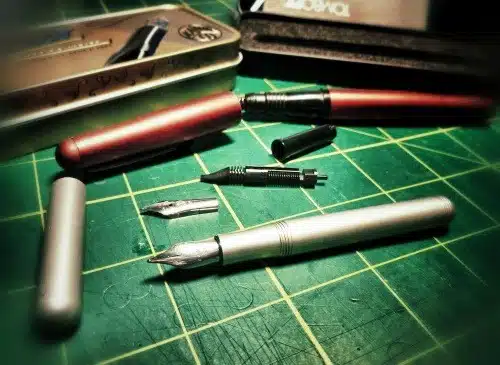
    I recently got a new fountain pen. (Yeah, I know: new typewriter, new fountain pen”¦ We’ll get to that in a moment.) I always carry my pen in my pocket, and while I liked the nib of the one I had, a Tombow Object, I found it heavy, and its innards clattered around while I was writing. Plus I love small things — ultimate portability seems to be an ideal of mine — so when I saw the Kaweco Lilliput, I really wanted it.

    (I’m ashamed of wanting things. When they’re named “Object” it’s even worse.)

    The Lilliput had good reviews online and sounded like the perfect pen for my tiny handwriting and need for precision when I write shorthand. When it arrived and I started using it, though, I found it scratchy, and it dried out if I paused for even a short time. Uh-oh.

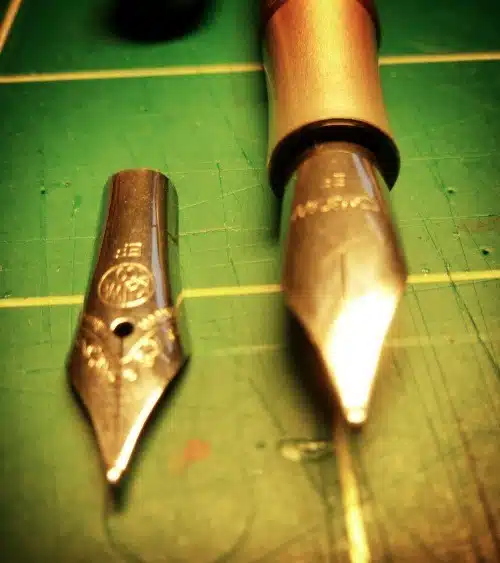
    So yesterday after work, I plucked out the nibs from both pens and”¦ whaddyaknow? They were exactly the same size, so I swapped them.

    The nib that came with the Kaweco is much nicer-looking, with etched scrollwork that adds to the feeling that this pen dropped out of time in the Forties and somehow reappeared here, but”¦ scratchy and dry is just bad.

    I used this new Frankenpen to write today’s morning pages, and it was just a perfect writing experience. Once again, DIY has allowed me to customise some small piece of the world to work exactly the way I want it to.

    “¦Which brings me around to something that came up in the morning pages:

    I am very good at setting up the perfect conditions for doing creative work. But I have become more accustomed to doing this than to actually doing creative work. I like my systems, and they are rewarding but it’s a trap to hide them them and not do the work. I have created the very best in security blankets. My systems are excellent: I have the best pen, typewriter, notebooks, programs, schedule, packages, delivery channels”¦ Now it’s time to put them to use. I’m not knocking what I’ve created — I’m proud of these achievements and I know my attention to them will help me become a better teacher to others. But, you know”¦ Again, I’m not making myself wrong here. But I’m all packed, and now there’s another adventure ahead.

  • New typewriter, new story

    I got a new typewriter in the post today.

    I wrote a little story on it just now, after finishing an exhausting transcript for work and culling out the teensy bits that were actually usable as testimonials.

    But I did it! I wrote something! I even let down my guard and allowed myself to go with a science fictiony idea that popped into my head this morning. (Which, please note, is a complete fiction; no trouble here in paradise.)

    The Olympia is noisy as all holy hell and the typeface is strange, but the keys sure are snappy! And the text it lays down is deep and crisp and even (as the song says). The character recognition function of my scanning program even managed to snag every word perfectly (barring the typos, which were my fault).

    So the old Empire-Corona is up on eBay. Much as I liked its simplicity and classic “typewriter”-looking output, I just couldn’t imagine getting a whole novel on it, nor that its fumbling lines of letters would scan reliably. It wasn’t quite the carnival strength-test of some of the machines I’ve used, but it was more kitschy-cool than a practical work machine.

    And I do want to get to work soon. The other work.

  • On fans

    A reader e-mailed me, saying some really nice stuff about my first novel. In my reply, I managed to articulate something that’s been at the back of my head for a while:

    What an amazing thing, that we can create imaginary worlds, events, and people, then have others share them with us!

    I remember the day I finished doubleZero in a cruddy back-alley shambles of a café-in-a-warehouse in Toronto. I was there with my friend Bert, typing away on my Newton, when I entered the final words and realised I was finished. I started crying, realising that I wasn’t going to get to be with those people anymore. They had become quite real to me.

    I’ve had other relationships since — with characters like Hugh, Simon, Stefan, Peter, Jeremy, Victor, and Despendra — because our first love is seldom our last. The whole process is still pretty magical to me, and I’ve been away from it long enough that, to be honest, I’m scared by it. Which is silly, especially when I’ve got so much proof that I can do it consistently and even have a process for doing it that I’ve taught other people.

    I guess it’s the measurement thing: because none of my books made a big splash (in that way we imagine outside forces are somehow going to take responsibility and make such a thing happen), it’s like going back into dating after being repeatedly heartbroken.

    When I was dating, I got this feeling like there was soot accumulating in my heart with every rejection or disappointment, and that this dark stuff would eventually be the end of me. What a beautiful surprise, then, to meet the person who’d become my spouse, and find all of that accreted stuff blown away from every last corner. I had a fresh start.

    I guess this is how it is for writers, too. As much as I hate celebrity culture and honestly do not want to become famous, there’s a certain validation in hearing someone say that they let their imagination participate in one of my stories and loved being in that place. It completes the circle of the creative act. I imagine the effect is exactly the same whether it’s one person or a million.

    I was taught in theatre school never to ask “So what did you think?” because it’s unfair to put others in that position, and because they might actually tell you what they thought. If their reaction is bad, even though you know that their reaction is completely personal and subjective, you still have to go on with the show, and that’s difficult to do with harsh words in your head about the thing you’re doing.

    Today I encounter the world with the great benefit of having someone behind me, shielding my spotless heart. Is this what we need as creatives? Not unquestioning ‘yes-man’ sycophants, but, well, fans?

    Perhaps this is part of the process, and I need to go back and create a swatch-file of that sort of correspondence I’ve received, because for whatever reason, the mind doesn’t ever seem to hold onto the good stuff. It’s back to Square One every time in the land of conditioned mind, where we’re taught that we’re unacceptable by nature and have to earn our way into virtue. But as Zen teacher Cheri Huber says, “If self-improvement worked, it would have by now.”

    I insist that everyone has the right to create, but there’s another jump to make from that place to the place where we have the courage to notice, value, and make use of the ideas that come to us. And perhaps there’s nothing wrong in needing help with that.