I’m about to ruin your life.
Okay, maybe not your life, but certainly your enjoyment of a lot of popular media, because once you see this principle I’m about to mention, you can’t un-see it.
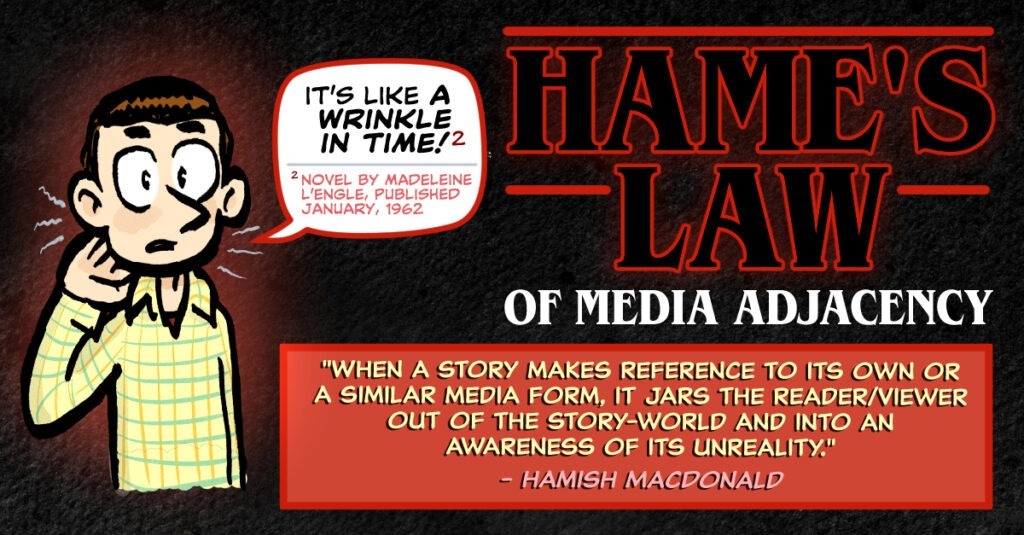
I’ve called it Hame’s Law of Media Adjacency, and it goes like this:
When a story makes reference to its own or a similar media form, it jars the reader/viewer out of the story-world and into an awareness of its unreality.
Case in point, the latest series of “Stranger Things”: Okay, I get that the whole thing is a nostalgic love-letter to the stories and games that we GenXers hold dear. But it’s one thing to be inspired and entirely another to have characters constantly speak your influences out loud in the story.
I present Exhibit A:
Max: “Only, I wasn’t actually there. Not really. I was just… an observer. And that’s when I understood. I was trapped inside Henry’s mind, his memories. Like a nightmare prison world ruled by an evil, psychopathic piece of sh*t.”
Holly: “Like Camazotz.”
Max: “What?”
Holly: “Camazotz. From A Wrinkle in Time.”
Max: “Never read it.”
Holly: “You should. It’s amazing. Camazotz is like this dark planet that’s under the control of IT, which is this giant, disembodied, evil brain. Anyway, Meg’s dad, Meg’s the main character, he gets taken prisoner there. So, Henry’s kinda like IT, and you’re kinda like Meg’s dad.”
This sort of thing kills the vibe dead for me, instantly, every time.
Credit to the makers of this show that they still managed to get me back, particularly with THAT ENDING (zips lips) which surely gave a thrill of satisfaction to every one of us bullied nerds.
But it was awfully close.
So if you tell stories, please don’t do this!